

Price ranges per m² installed
These are Prime Surfaces prices in US dollars per square meter installed, meaning surface preparation, materials and labor are all in:
- Flake (decorative chip): $70–$90/m².
- Metallic marble: $100–$120/m².
- Solid color: no published price. It is quoted per space, because it goes into everything from a small living room to a full warehouse.
Metallic costs more because it is more hands-on: the pigments are worked by hand over wet resin to form the veining, which is also why no two floors come out alike. Flake goes down faster and is more forgiving of imperfections in the slab.
The final figure is always confirmed at an on-site assessment, which is free. Further down we explain why a firm price without seeing the floor should make you cautious.
If you think in square feet: 1 m² is about 10.76 sq ft, so a 36 m² garage is roughly 390 sq ft.
Worked examples for typical areas
To give you a sense of scale, this table multiplies the per-m² range by areas that are common in Costa Rican homes and businesses. These are reference ranges, not quotes.
| Space | Area | Flake | Metallic |
|---|---|---|---|
| One-car garage | ~18 m² | $1,260–$1,620 | $1,800–$2,160 |
| Two-car garage | ~36 m² | $2,520–$3,240 | $3,600–$4,320 |
| Living and dining area | ~40 m² | $2,800–$3,600 | $4,000–$4,800 |
| Retail space | ~80 m² | $5,600–$7,200 | $8,000–$9,600 |
Two things to keep in mind. First, measure your actual space: a “two-car” garage can be 30 m² or 45 m². Second, the larger the area, the better the price per m². Getting the crew, grinders and materials on site costs nearly the same for 18 m² as for 80 m², so bigger projects tend toward the low end of the range and very small ones toward the high end.
For a calculation with your exact area, the price estimator does it in seconds, before asking for any contact details.
What moves the price up or down
Within each range, these are the factors that matter:
- Condition of the concrete. A sound, level, uncoated slab is the cheapest case. Dusty, oil-stained or very uneven concrete takes more preparation hours.
- Repairs. Cracks, open joints and spalling are fixed before coating. A few hairline cracks barely register; a heavily cracked slab does.
- Moisture. The assessment includes a moisture reading (the slab should be below 4% per ASTM F1869). If moisture is coming up through the concrete, it has to be dealt with first or the system can fail. Sometimes that means waiting; sometimes an additional treatment.
- Removing an existing floor. Taking up tile, vinyl or old paint is separate work. In many cases epoxy can go over existing tile once it has been evaluated, which saves the demolition.
- Area. As above, more square meters means a lower unit cost.
- Finish. Between systems the gap is clear (flake vs. metallic). Within a system, multi-color designs or more elaborate effects take more material and time.
- Location. We are based in Santa Ana. A project in the Greater Metropolitan Area is not the same as one in Guanacaste or Jacó and Manuel Antonio, where the crew travels and stays over.
What the price includes, and what it does not
Included:
- Mechanical surface preparation (machine grinding or polishing) and minor crack repair.
- All system materials: 100% solids epoxy base, metallic pigment or flake, and the sealing coat.
- Installation labor, typically 3 to 5 working days depending on area and weather.
- Care recommendations at handover.
Not included unless quoted separately:
- Structural slab repairs (settlement, active cracks, drainage problems).
- Removal of existing flooring and disposal of the debris.
- Moving furniture, equipment or vehicles. The space needs to be handed over empty.
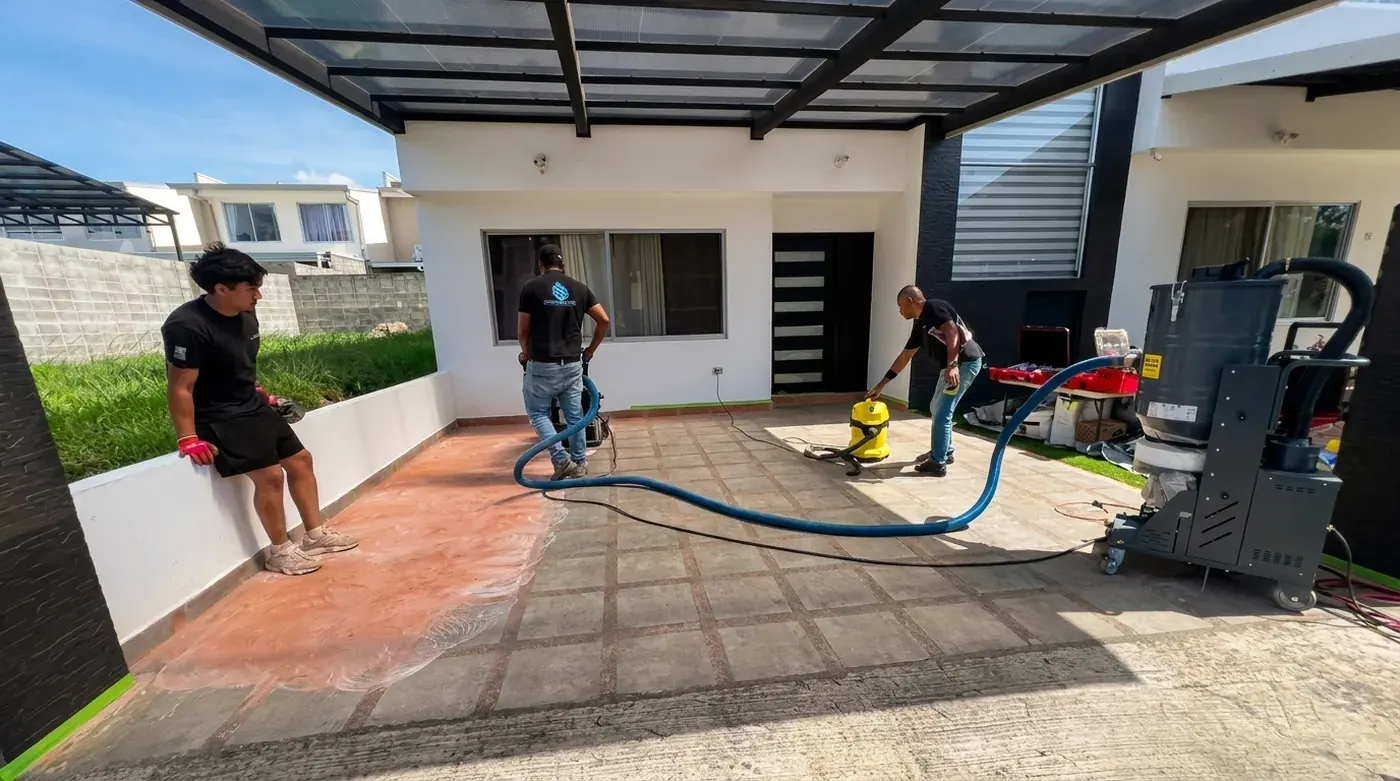
Why very low prices deserve a second look
If you are offered a floor at a fraction of these ranges, you are almost certainly not being quoted the same thing. “Epoxy” covers very different products:
- Hardware-store epoxy paint. A paint with some resin in it, thinned with water or solvent. Once dry it leaves a very thin film. It is rolled on, often over concrete that has only been washed.
- A 100% solids epoxy system. No thinner: everything applied stays on the floor as resin. It goes down in several coats over mechanically opened concrete and reaches 350 psi of bond strength. In practice, the concrete gives way before the bond does.
You will not see the difference on day one. You see it months later: thin paints over unprepared concrete tend to peel, especially in garages, where hot tires and moisture test the bond. Redoing a failed floor costs more than doing it right once, because the old coating has to come off first.
When comparing quotes, ask three questions. How is the concrete prepared? Is the epoxy 100% solids? How many coats, and what is it sealed with? Our process page shows our own answers step by step.
How to get a firm quote
- Estimate. Use the estimator to check the project fits your budget.
- Book the free assessment. We visit, measure, check moisture and slab condition, and talk through how the space is used.
- Choose the finish. Browse the finish lab or try one on a photo of your own room in See your space. You see a physical sample before installation.
- Get the fixed price. Once the area and the substrate are known, the quote stops being a range.
- Schedule. A 50% deposit reserves the date; the balance is due on handover.